

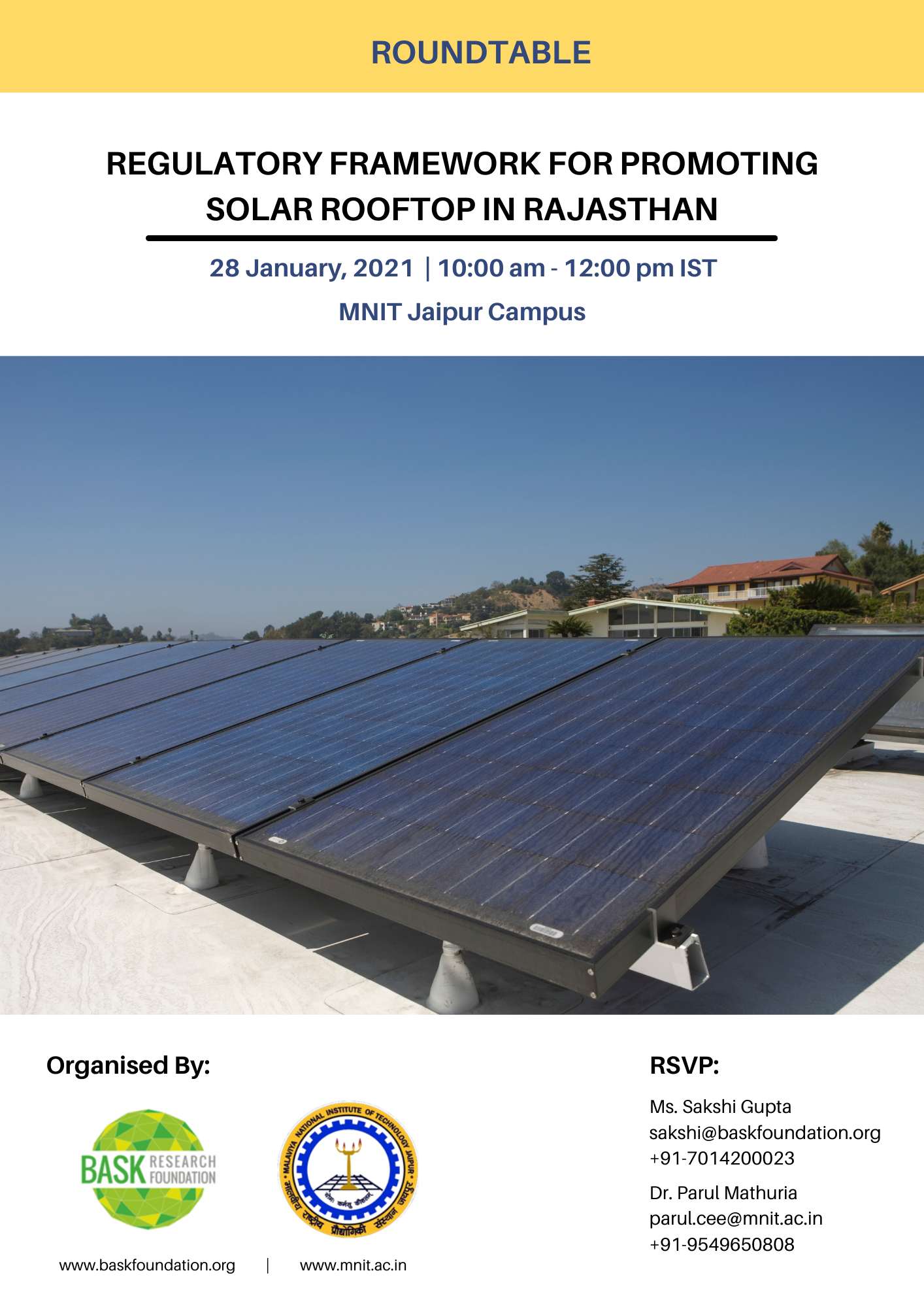
RERC’s draft regulations on grid-interactive distributed renewable energy raised serious concerns among solar rooftop developers and civil society organisations. To address these, CEEP and the Centre for Energy and Environment (MNIT, Jaipur) organised a roundtable where representatives from leading policy and research organisations, along with industry experts, discussed key stakeholder issues. Participants highlighted the potential social and economic impacts of the proposed regulations, particularly on SMEs and local employment. Stakeholders' views were submitted to the Commission, urging the adoption of a fair regulatory framework to promote solar rooftop systems in Rajasthan.
Rajasthan Electricity Regulatory Commission (RERC) has notified draft RERC (Grid Interactive Distributed Renewable Energy Generating Systems) Regulations 2020. The said regulations have raised serious concerns amongst solar rooftop project developers and civil society organisations who have been advocating for promotion of distributed solar in Rajasthan.
Centre for Energy, Environment and People (formerly known as Bask Research Foundation) and Center for Energy and Environment (MNIT, Jaipur) organised a roundtable on January 28 to discuss key concerns of stakeholders and place them for consideration of the Commission. Representatives of esteemed policy and research organisations such as Prayas Energy Group, Council for Energy Environment and Water, World Resources Institute and Indicc Associates presented their views. Mr. Sachin Bansal, General Secretary of Rajasthan Solar Association, Mr. Ashu Gupta from Design to Occupancy and Mr. Sandeep Gurnani from Solar 91 Cleantech expressed concerns of solar rooftop developers.
Participants highlighted that the proposed regulations in their current format shall have a significant social and economic impact in Rajasthan. Industries, especially SME segment, in Rajasthan are already finding it difficult to compete in national and international markets because of high electricity tariffs. Curtailment of modest incentives through feed-in-tariffs for adoption for solar rooftop is likely to further impact the competitiveness of local industry. At the same time, solar rooftop segment is creating significant direct and indirect local employment which shall also suffer.
The organisations submitted the views of the stakeholders to the Commission for consideration and appealed for formulation of a fair and transparent regulatory framework for promoting solar rooftop systems in Rajasthan.
RERC’s draft regulations on grid-interactive distributed renewable energy raised serious concerns among solar rooftop developers and civil society organisations. To address these, CEEP and the Centre for Energy and Environment (MNIT, Jaipur) organised a roundtable where representatives from leading policy and research organisations, along with industry experts, discussed key stakeholder issues. Participants highlighted the potential social and economic impacts of the proposed regulations, particularly on SMEs and local employment. Stakeholders' views were submitted to the Commission, urging the adoption of a fair regulatory framework to promote solar rooftop systems in Rajasthan.
Rajasthan Electricity Regulatory Commission (RERC) has notified draft RERC (Grid Interactive Distributed Renewable Energy Generating Systems) Regulations 2020. The said regulations have raised serious concerns amongst solar rooftop project developers and civil society organisations who have been advocating for promotion of distributed solar in Rajasthan.
Centre for Energy, Environment and People (formerly known as Bask Research Foundation) and Center for Energy and Environment (MNIT, Jaipur) organised a roundtable on January 28 to discuss key concerns of stakeholders and place them for consideration of the Commission. Representatives of esteemed policy and research organisations such as Prayas Energy Group, Council for Energy Environment and Water, World Resources Institute and Indicc Associates presented their views. Mr. Sachin Bansal, General Secretary of Rajasthan Solar Association, Mr. Ashu Gupta from Design to Occupancy and Mr. Sandeep Gurnani from Solar 91 Cleantech expressed concerns of solar rooftop developers.
Participants highlighted that the proposed regulations in their current format shall have a significant social and economic impact in Rajasthan. Industries, especially SME segment, in Rajasthan are already finding it difficult to compete in national and international markets because of high electricity tariffs. Curtailment of modest incentives through feed-in-tariffs for adoption for solar rooftop is likely to further impact the competitiveness of local industry. At the same time, solar rooftop segment is creating significant direct and indirect local employment which shall also suffer.
The organisations submitted the views of the stakeholders to the Commission for consideration and appealed for formulation of a fair and transparent regulatory framework for promoting solar rooftop systems in Rajasthan.

MNIT, also known as NIT Jaipur, is one of India's earliest NITs and a distinguished research and educational establishment in Rajasthan which focuses on science, engineering, and management. The institution functions under the Ministry of Education (MoE), Government of India.
Date: 21 Jan, 2021
Time: 10:00 AM - 12:00 PM
Venue: Hybrid – Online and NKN-II, Prabha Bhavan, MNIT Jaipur
| Time | Event | Speaker |
|---|---|---|
| 10:00 AM – 10:05 AM | Welcome Note | Dr. Jyotirmay Mathur, MNIT Jaipur |
| 10:05 AM – 10:15 AM | Context Setting and Agenda | Simran Grover, Bask Research Dr. Parul Mathuria – Center for Energy & Environment, MNIT Jaipur |
| 10:15 AM – 10:30 AM | Valuing Grid Connected Rooftop Solar | Neeraj Kuldeep – Council on Energy, Environment and Water |
| 10:30 AM – 10:45 AM | Regulatory Framework For ‘Distributed Solar PV Rooftops’ – Experience From Maharashtra | Ashwin Gambhir – Prayas Energy Group |
| 10:45 AM – 12:00 PM | Roundtable Discussion | Feed-in-tariffs, Standards & Compliance, Rights and Responsibilities of Prosumers |
Please ensure all required fields (*) are filled out accurately.